
Are you planning to start a new small business? Or do you already own a shop or small enterprise that you want to expand, but a lack of capital is holding you back?
When approaching traditional banks for a business loan, applicants are usually asked to mortgage a property, land, or gold as collateral. For entrepreneurs who don’t have assets to pledge, their business dreams often stall before getting off the ground.
To solve this exact challenge, the Government of India launched the Pradhan Mantri MUDRA Yojana (PMMY). Reading this guide covers all aspects of the MUDRA loan scheme without needing to search elsewhere.
1. What is the MUDRA Loan Scheme?
MUDRA stands for Micro Units Development and Refinance Agency. In simple terms, it is a Government of India initiative that enables small business owners, shopkeepers, and new entrepreneurs to access collateral-free business loans (loans without pledging property or assets).
The primary objective of the scheme is to bring formal, affordable credit to micro-enterprises across the country.
2. MUDRA Loan Categories: How Much Funding Can You Get?
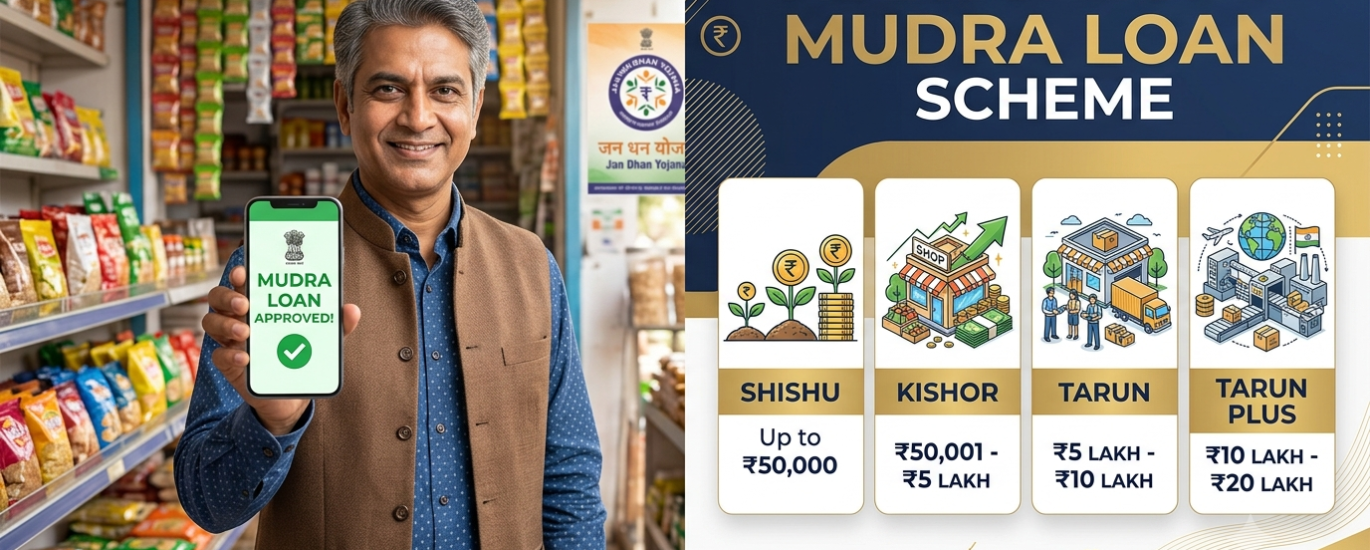
The government categorizes MUDRA loans into 4 tiers based on business stage and funding requirement:
- Shishu Category:
- Loan Amount: Up to ₹50,000.
- Best For: Individuals launching a brand-new micro-business or early-stage setup.
- Kishor Category:
- Loan Amount: ₹50,001 to ₹5 Lakh.
- Best For: Established small businesses that need funds for working capital, stocking inventory, or buying equipment.
- Tarun Category:
- Loan Amount: ₹5 Lakh to ₹10 Lakh.
- Best For: Growing businesses requiring substantial capital for expansion.
- Tarun Plus Category:
- Loan Amount: ₹10 Lakh to ₹20 Lakh.
- Best For: Experienced business owners who have previously taken a ‘Tarun’ category loan and successfully repaid it in full.
3. Key Benefits of a MUDRA Loan
- No Collateral Guarantee Needed: You do not need to mortgage your shop, house, or land to secure funding.
- Zero Processing Fee for Shishu: Banks do not charge processing fees on loans under the ‘Shishu’ category.
- MUDRA Card Access: Sanctioned working capital limits come with a specialized Debit Card (MUDRA Card), allowing you to withdraw cash from ATMs for daily business expenses.
- Flexible Tenure: Repayment schedules typically range from 3 to 7 years with manageable equated monthly installments (EMIs).
4. Eligibility Criteria: Who Can Apply?
Any Indian citizen who has an income-generating business plan in non-farm manufacturing, trading, or services can apply.
Who IS Eligible?
- Retail shopkeepers (Kirana stores, apparel outlets, mobile shops, hardware stores).
- Street vendors, food stall owners, and small traders.
- Service providers (tailors, salon owners, repair technicians, artisans).
- Small manufacturing units (bakery, handicrafts, food processing, packaging units).
- Allied agricultural activities (dairy farming, poultry, beekeeping, fish farming).
Who IS NOT Eligible?
- Individuals seeking loans for personal expenses (weddings, home construction, personal travel).
- Direct crop farming or land cultivation activities (standard agricultural crop loans apply there instead).
5. Required Documents Checklist
Applying for a MUDRA loan requires straightforward paperwork:
- Identity Proof: Aadhaar Card, PAN Card, Voter ID, or Driving License.
- Address Proof: Electricity bill, Ration Card, or Aadhaar Card.
- Business Registration Proof: Shop & Establishment License, Udyam MSME Certificate, Rent Agreement, or GST registration (if applicable).
- Bank Account Statements: Last 6 months’ bank passbook or statement.
- Passport-Sized Photographs: 2 to 3 recent copies.
- Price Quotations: Quotation invoice if the loan is intended for buying specific machinery or equipment.
6. Interest Rates & Charges
There is no single fixed interest rate set by the government; each participating bank sets its rate based on Reserve Bank of India (RBI) guidelines. Rates generally fall between 8.5% and 12% per annum.
Your final interest rate depends on:
- Your CIBIL/Credit score history.
- Your business vintage and profile risk evaluation.
7. How to Apply Step-by-Step
There are two straightforward ways to submit your MUDRA loan application:
Method 1: Apply Offline (Direct Bank Branch)
- Visit your nearest Public Sector Bank (e.g., SBI, Punjab National Bank, Bank of Baroda), Regional Rural Bank, or commercial bank.
- Request a MUDRA Loan Application Form from the desk.
- Fill out the details carefully and attach all required document copies.
- Submit the file to the loan officer. Once verified, the bank processes the loan sanction.
Method 2: Apply Online (Via JanSamarth Portal)
- Visit the official central government portal: jansamarth.in.
- Select “Business Activity Loan” and choose the MUDRA scheme.
- Enter your basic details to check instant eligibility.
- Upload your documents online and select your preferred lending bank from the digital list.
- Submit the application to initiate digital processing.
8. Common Reasons for Loans Get Rejected (And How to Avoid Them)
If a MUDRA loan application gets rejected, it is usually due to one of these common mistakes:
- Poor Credit Score: A past default on personal loans or credit cards negatively impacts your CIBIL rating.
- Inconsistent Documents: Mismatched names or addresses across your Aadhaar, PAN, and Bank accounts cause verification holds.
- Vague Business Model: Lenders need confidence that the business will generate enough income to cover monthly EMIs.
- Paying Agents or Middlemen: The government does not authorize third-party agents for MUDRA loans. Always deal directly with official bank staff or the jansamarth.in portal.
Frequently Asked Questions (FAQs)
Q1: Is Udyam MSME Registration compulsory for a MUDRA Loan? While not strictly mandatory for every small category, holding a free Udyam MSME Certificate significantly speeds up verification and loan approval.
Q2: Can first-time business owners apply directly for ₹20 Lakh under Tarun Plus? No. The ₹20 Lakh limit under ‘Tarun Plus’ is strictly reserved for business owners who have previously taken and fully repaid a ‘Tarun’ category loan. First-time applicants can start under Shishu, Kishor, or Tarun depending on business needs.
Q3: Is there a subsidy on a MUDRA Loan? MUDRA is a direct credit scheme, not a subsidy scheme. If you are looking for government capital subsidies (up to 35%), look into the PMEGP Scheme.




One thought on “Pradhan Mantri MUDRA Loan Scheme Explained: Every Question Answered in One Place”