
Quick Answer
Saving money on a low salary in India starts with understanding your monthly expenses, prioritising essential needs and setting aside a manageable amount regularly. You do not need a high income to begin saving. Even ₹500 or ₹1,000 per month can help you build a financial cushion when you save consistently and avoid unnecessary debt.
The right savings plan depends on your salary, rent, family responsibilities, debt repayments and cost of living. Focus on building a routine that you can maintain instead of following an unrealistic savings target.
Key Facts About Saving on a Low Salary
- Start by tracking your income and expenses for one month.
- Pay for essential needs before discretionary spending.
- Save a fixed amount after receiving your salary, even if it is small.
- Build an emergency fund before taking unnecessary investment risks.
- Review subscriptions, food delivery, transport and impulse purchases.
- Increase your savings whenever your income rises or an expense decreases.
The Securities and Exchange Board of India recommends budgeting, tracking expenses and allocating money regularly towards savings and investments. The Reserve Bank of India also explains that savings can help households manage unexpected expenses and periods of financial difficulty.
1. Understand Where Your Salary Goes
The first step towards saving money is identifying where your income is being spent. Many people underestimate small daily purchases because individual transactions appear affordable.
Record your rent, groceries, electricity, mobile bills, transport, loan repayments, medical expenses and discretionary purchases. You can use a notebook, spreadsheet or expense tracking application to identify spending that can be reduced.
For a practical method, read our guide on how to track monthly expenses in India.
Example of monthly spending on a ₹20,000 salary
| Expense category | Monthly amount |
|---|---|
| Rent and household contribution | ₹6,000 |
| Groceries and meals | ₹4,000 |
| Transport | ₹2,000 |
| Electricity, mobile and internet | ₹1,000 |
| Family and medical expenses | ₹2,000 |
| Personal spending | ₹2,000 |
| Savings | ₹1,000 |
| Remaining buffer | ₹2,000 |
| Total | ₹20,000 |
This is an illustrative budget, not a recommended spending limit for every household. If your rent, medical costs or family responsibilities are higher, adjust the categories to match your actual situation.
2. Create a Monthly Budget That Fits Your Income
A realistic budget helps you decide how much to spend, save and reserve for unexpected expenses. It also makes it easier to identify the categories where you can reduce spending without affecting essential needs.
Start by dividing your salary into essential expenses, discretionary expenses, debt repayments and savings. If your essential expenses consume most of your income, focus first on controlling flexible spending and avoiding new debt.
Use our monthly budget planner guide for India to organise your income and expenses.
Should you follow the 50/30/20 budget rule?
The 50/30/20 rule is a budgeting framework that allocates 50% of income to needs, 30% to wants and 20% to savings and debt repayment. However, this split may not be practical for someone earning a low salary in a city with high rent or supporting several family members.
You can start with smaller savings contributions and increase them when your financial situation improves. The purpose of a budget is to support your needs and financial goals, not to force you into an unsuitable formula.
Read our detailed guide to the 50/30/20 budget rule in India.
3. Set a Small and Achievable Savings Target
A small, consistent savings target is more useful than a large target that you cannot maintain. Choose an amount that leaves enough money for essential bills, food, transport and other necessary commitments.
The following examples show how different monthly contributions can build up over time. They do not include interest or investment returns.
| Monthly salary | Example monthly saving | Savings in one year |
|---|---|---|
| ₹10,000 | ₹300 | ₹3,600 |
| ₹15,000 | ₹500 | ₹6,000 |
| ₹20,000 | ₹1,000 | ₹12,000 |
| ₹25,000 | ₹1,500 | ₹18,000 |
| ₹30,000 | ₹2,000 | ₹24,000 |
These amounts are examples, not mandatory targets. If your income is insufficient to cover basic needs, focus on meeting essential expenses, managing debt and exploring ways to increase income before setting an aggressive savings goal.
For more salary based examples, read how much you should save every month in India.
4. Reduce Expenses Without Compromising Essential Needs
Reducing avoidable spending can free up money for savings without requiring an immediate increase in income. Focus on expenses that you can control rather than cutting necessary food, healthcare or basic household requirements.
Consider these practical changes:
- Plan meals at home: Prepare a weekly meal plan and carry meals when practical to reduce frequent food delivery costs.
- Review subscriptions: Cancel services that you rarely use.
- Compare mobile plans: Choose a plan that matches your actual data and calling requirements.
- Plan transport: Compare public transport, shared travel and other suitable commuting options.
- Reduce impulse purchases: Wait before buying non essential items and compare prices.
- Track small transactions: Review tea, snacks, online purchases and convenience fees at the end of each week.
- Plan shopping: Make a list before visiting a store and avoid buying items that are not required.
The aim is to reduce wasteful spending while protecting your health, work needs and family responsibilities.
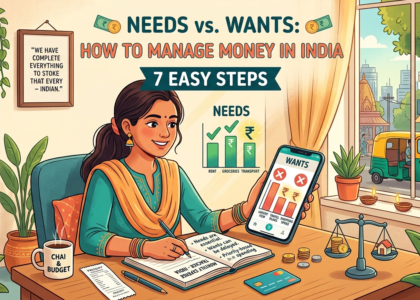
Understand the difference between needs and wants
Needs include essential food, housing, basic utilities, necessary transport and healthcare. Wants include optional purchases such as premium subscriptions, frequent restaurant meals and upgrades that you can postpone.
A purchase can be necessary for one household and optional for another. Read our guide on needs vs wants and how to manage money to make more informed spending decisions.
5. Build an Emergency Fund Gradually
An emergency fund helps you manage unexpected expenses without immediately relying on credit cards or personal loans. It can be useful when you face medical costs, temporary unemployment, urgent repairs or a sudden reduction in income.
Start with a small target, such as ₹5,000 or ₹10,000, if that is realistic for your circumstances. After reaching it, work towards a reserve that covers several months of essential expenses. A common planning guideline is three to six months of essential expenses, although the appropriate amount depends on income stability, dependants and other financial commitments.
For example, if your essential monthly expenses are ₹12,000, a three month reserve would be ₹36,000. You do not need to build this amount immediately. Save gradually and keep emergency money accessible in a suitable, relatively low risk place.
Learn more in our guide to building an emergency fund in India.
6. Avoid Using Loans to Maintain Your Lifestyle
Frequent borrowing for everyday spending can make saving more difficult because repayments and interest reduce the money available from future salaries. Review existing debts and make a plan to pay required instalments on time.
Try these steps:
- Avoid taking a new loan for non essential purchases when your budget is already tight.
- Pay at least the required amount on time for existing credit commitments.
- Review the interest rate, fees and outstanding balance on each debt.
- Prioritise expensive debt repayment while maintaining a small cash buffer for essential emergencies.
- Contact your lender if you are struggling to meet repayments rather than ignoring missed payments.
Do not use all your available cash to repay debt if doing so would leave you unable to afford food, rent, medicine or transport to work. Balance debt reduction with immediate financial needs.
7. Save Automatically on Salary Day
Saving money becomes easier when you make it a regular habit instead of waiting until the end of the month. If possible, transfer your chosen savings amount to a separate account shortly after receiving your salary.
For example, you could set an automatic transfer of ₹500 per month. If that amount becomes comfortable after a few months, increase it to ₹700 or ₹1,000.
Keep the process simple:
- Decide on an affordable monthly amount.
- Set a recurring transfer if your bank supports it.
- Keep savings separate from your regular spending balance.
- Review your budget at the end of each month.
- Increase the amount only when your finances allow it.
If you have an irregular income, save a percentage of the money you receive when practical, while keeping enough available for essential expenses.
8. Look for Ways to Increase Your Income
Reducing expenses has limits, particularly when most of your salary goes towards basic needs. In that situation, increasing income may be more effective than trying to cut every remaining expense.
Depending on your skills, time and circumstances, you could consider:
- Applying for a better paying role.
- Learning a skill that is relevant to your career.
- Taking suitable freelance assignments outside working hours.
- Offering tutoring or other services based on your expertise.
- Selling unused items that are still in good condition.
- Exploring a small side business after accounting for its costs and risks.
Do not assume that additional work will generate guaranteed income. Check the time commitment, initial costs, employment restrictions and tax implications before starting.
When your income increases, direct part of the additional money towards savings rather than immediately increasing all your spending.
9. Choose Where to Keep Your Savings
The right place for savings depends on when you may need the money and how much risk you can afford. Money intended for an emergency should generally remain accessible, rather than being placed entirely in investments that can fluctuate in value.
| Financial purpose | General approach |
|---|---|
| Daily expenses | Keep enough money in your regular transaction account |
| Immediate emergencies | Consider an accessible savings account or another suitable low risk option |
| Planned expenses in the near future | Consider options that match the time until the money is needed |
| Goals several years away | Research suitable savings and investment choices based on risk, liquidity and time horizon |
Bank deposits are subject to the applicable terms and conditions. Eligible deposits are insured by the Deposit Insurance and Credit Guarantee Corporation up to ₹5 lakh per depositor per bank, including principal and interest, subject to its rules.
Investment products are not the same as bank deposits. Market linked investments can lose value, so do not put money needed for immediate essentials into investments you do not understand.
Pros and Cons of Saving on a Low Salary
Advantages
- Builds financial discipline and confidence.
- Creates a buffer against unexpected expenses.
- Reduces dependence on borrowing when emergencies occur.
- Helps you plan for education, family needs and future purchases.
- Makes it easier to work towards financial goals gradually.
Challenges
- Rent, healthcare and family responsibilities may leave little money to save.
- Inflation can increase essential household costs.
- Debt repayments may limit your ability to set aside money.
- Irregular income can make fixed monthly contributions difficult.
The best approach is to adjust your plan as your circumstances change. Saving a small amount is a useful start, but meeting essential needs and avoiding harmful debt should remain priorities.
Example: How a Person Earning ₹15,000 Can Start Saving
Suppose a person earns ₹15,000 per month and contributes towards household expenses. After reviewing actual spending, the person identifies ₹500 that can be saved without missing essential payments.
| Item | Monthly amount |
|---|---|
| Take home income | ₹15,000 |
| Essential expenses and commitments | ₹12,500 |
| Flexible spending | ₹2,000 |
| Savings | ₹500 |
| Total | ₹15,000 |
Saving ₹500 every month would produce ₹6,000 over one year, before interest. If the person receives a salary increase or reduces an expense, the monthly contribution could rise.
If essential expenses already exceed ₹15,000, this example will not fit. In that situation, review the budget, check whether any benefits or support are available, assess debt obligations and explore realistic ways to improve income.
Expert View: What Matters Most When Your Salary Is Low?
An effective savings plan should reflect your actual income and financial obligations, rather than an ideal percentage copied from someone else. The RBI and SEBI financial education resources emphasise budgeting, understanding expenses, regular saving and setting realistic financial goals.
For someone on a low salary, the sensible order is to cover essentials, keep up with required debt payments, build a small emergency reserve and gradually increase savings. Investment decisions should come after you understand your immediate cash needs, risk tolerance and goals.
Frequently Asked Questions
1. How can I save money on a ₹10,000 salary in India?
Start by recording essential expenses and identifying any amount you can set aside without compromising food, housing, healthcare or transport. If your budget permits, begin with ₹100 to ₹300 per month and review your finances regularly. If there is no surplus, focus on reducing avoidable costs or improving income before setting a savings target.
2. How much should I save from a ₹15,000 salary?
There is no universal amount that everyone earning ₹15,000 should save. You could begin with ₹300 or ₹500 if your essential expenses and debt repayments allow it. If you support dependants or pay high rent, your affordable contribution may be lower.
3. Is saving ₹500 per month useful?
Yes. Saving ₹500 each month adds up to ₹6,000 in a year before interest. This can be a useful starting emergency reserve, although it may not cover a major unexpected expense.
4. What is the best way to control monthly expenses?
Track every major expense, separate needs from wants, plan purchases and review recurring payments. A written budget helps you see where money is going and decide which changes are practical.
5. Should I save money or repay debt first?
You generally need to keep essential bills current and make required debt payments on time. If you have expensive debt, consider prioritising repayment while maintaining a small emergency buffer so that a minor unexpected expense does not force you to borrow again.
6. Where should I keep emergency savings?
Consider an accessible and relatively low risk option, such as a suitable bank savings account. Compare access, fees and applicable terms before choosing. Avoid placing all emergency money in investments that may fall in value or take time to withdraw.
7. How can I save money when my salary is not enough?
First, check whether the shortfall comes from essential expenses, debt repayments or discretionary spending. Reduce costs where it is practical, explore available assistance if relevant and consider ways to improve your income. Do not sacrifice essential food, healthcare or housing just to meet an arbitrary savings target.
8. Should I invest before building an emergency fund?
Money needed for immediate expenses should generally be kept accessible and relatively low risk. Build a suitable emergency reserve before committing money to investments that can fluctuate or may not be easy to withdraw when needed.
Sources
- SEBI Investor Education: Why Save
- SEBI Investor Education: Management of Income and Expenses
- SEBI Investor Education: Financial Goals and Budgeting
- Reserve Bank of India: Financial Awareness Messages
- DICGC: Deposit Insurance Information
This article is for general educational purposes and does not constitute personalised financial advice. Review your own income, expenses, debt and financial goals before making financial decisions.