Managing money becomes easier when you have a clear plan for your income, expenses, savings and financial goals. A monthly budget helps you understand where your money goes and gives every part of your income a specific purpose.
SEBI describes budgeting as part of financial planning because it helps individuals track income, expenses, savings and investments while working toward financial goals.
Quick Answer
A monthly budget is a plan that divides your take home income between essential expenses, lifestyle spending, savings, investments and debt payments. To create one, calculate your monthly income, list your expenses, separate needs from wants, set savings goals and review your spending regularly.
There is no single budget that works for every Indian household. Your ideal budget depends on your income, rent, EMIs, family responsibilities, financial goals and lifestyle.
Key Facts About Monthly Budgeting
- Use your take home income when preparing a monthly budget.
- Include both regular and irregular expenses.
- Separate essential expenses from discretionary spending.
- Treat savings as a planned monthly allocation.
- Keep a separate allocation for unexpected expenses.
- Review your budget at least once every month.
- Adjust your budget when your income or financial responsibilities change.
SEBI recommends reviewing and revising a financial plan as circumstances change. RBI financial education material also highlights regular saving as a way to prepare for higher expenses and unexpected events.
What Is a Monthly Budget?
A monthly budget is a plan that shows how you intend to use your income during a particular month. It connects your current income with your everyday expenses and longer term financial goals.
A simple calculation is:
Monthly Income − Monthly Expenses = Money Available for Savings, Investments or Debt Repayment
For example, if your take home income is ₹60,000 and your monthly expenses are ₹42,000, you have ₹18,000 available for savings, investments, debt repayment or other financial priorities.
A good budget does not mean avoiding every non essential expense. It means deciding how much you can spend while still making progress toward your financial goals.
Why Should You Create a Monthly Budget?
A monthly budget gives you better visibility over your money. It can help identify unnecessary spending and show how much you can realistically save each month.
SEBI states that budgeting can help control excessive expenditure, improve decision making and use available funds more efficiently.
Main benefits of budgeting
| Benefit | How it helps |
|---|---|
| Expense control | Shows where your money is going |
| Saving | Creates a planned amount for savings |
| Debt management | Helps allocate money toward EMIs |
| Emergency planning | Creates room for unexpected expenses |
| Financial goals | Connects monthly spending with future goals |
| Better decisions | Makes large purchases easier to evaluate |
If you are building a broader money management system, you can also read our Personal Finance Guide for Indians for related budgeting, saving and investing topics.
How to Create a Monthly Budget in India
1. Calculate Your Take Home Income
Start with the money that actually reaches your bank account each month. Do not use your annual CTC as the primary figure because your CTC can include components that are not available for monthly spending.
Include predictable sources of income such as salary, business income, rental income or other regular receipts. If your income changes every month, use a conservative estimate rather than your highest monthly income.
2. List Your Fixed Expenses
Fixed expenses are costs that usually remain similar each month.
| Expense | Example |
|---|---|
| Rent | ₹15,000 |
| Home loan EMI | ₹20,000 |
| Insurance | ₹2,000 |
| School fees | ₹5,000 |
| Internet | ₹1,000 |
| Other loan EMI | ₹5,000 |
Your actual expenses will depend on your household and financial commitments.
3. Track Your Variable Expenses
Variable expenses change from month to month. Common examples include groceries, electricity, fuel, eating out, shopping, entertainment and healthcare.
Review your bank statements and payment records from the previous two or three months. This gives you a more realistic estimate than relying on memory.
For a detailed system, see our upcoming guide on How to Track Monthly Expenses.
4. Separate Needs From Wants
Separating needs from wants helps you identify expenses that can be adjusted when your budget becomes tight.
Needs generally include:
- Housing
- Food
- Utilities
- Essential transportation
- Healthcare
- Insurance
- Required loan payments
Wants may include:
- Restaurant meals
- Entertainment
- Premium subscriptions
- Impulse purchases
- Non essential shopping
- Frequent leisure travel
This does not mean that every want should be removed. The objective is to allocate a reasonable amount without compromising essential expenses or financial goals.
For more guidance, read Needs vs Wants: How to Control Unnecessary Spending.
5. Decide How Much You Want to Save
Savings should be part of your budget rather than an amount you hope to have left at the end of the month.
Your savings allocation can support different objectives, including:
- Emergency savings
- Short term goals
- Future purchases
- Retirement planning
- Investments
Read our upcoming guide on How Much Should You Save Every Month? for a detailed salary based approach.
6. Build an Emergency Fund
An emergency fund provides financial support when unexpected expenses arise.
Possible emergencies include medical expenses, job loss, major repairs and unexpected family requirements. RBI educational material identifies savings as a resource that can help meet unexpected expenses and periods when income is unavailable.
Learn more in our detailed guide: How Much Emergency Fund Should You Have in India?.
7. Plan for Irregular Expenses
A monthly budget should also account for expenses that do not occur every month.
Examples include:
- Insurance premiums
- Vehicle servicing
- Annual subscriptions
- School expenses
- Festivals
- Travel
- Home repairs
- Major purchases
If an expected annual expense is ₹24,000, you can set aside ₹2,000 per month.
₹24,000 ÷ 12 = ₹2,000
This approach turns a large occasional expense into a smaller monthly allocation.
8. Choose a Budgeting Method
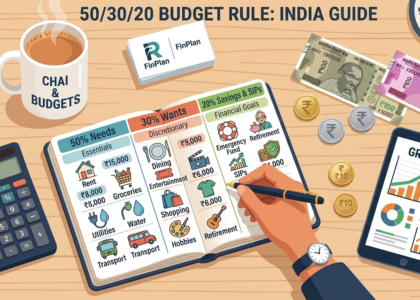
The 50/30/20 rule is one commonly used budgeting framework.
It generally divides after tax income into:
| Category | Suggested allocation |
|---|---|
| Needs | 50% |
| Wants | 30% |
| Savings and financial goals | 20% |
This should be treated as a framework rather than a mandatory rule. Housing costs, family responsibilities, debt and income levels can make another allocation more appropriate.
Read our dedicated guide: 50/30/20 Budget Rule in India.
Example: Monthly Budget for a ₹50,000 Salary
Consider a person with a monthly take home salary of ₹50,000.
An illustrative budget could look like this:
| Category | Monthly allocation |
|---|---|
| Rent and household expenses | ₹15,000 |
| Food and groceries | ₹7,000 |
| Transport and fuel | ₹4,000 |
| Utilities and phone | ₹2,500 |
| Insurance and healthcare | ₹2,500 |
| Lifestyle expenses | ₹4,000 |
| Emergency savings | ₹5,000 |
| Investments | ₹7,000 |
| Flexible buffer | ₹3,000 |
| Total | ₹50,000 |
This example is not a universal recommendation. Someone with a large home loan, dependent parents or higher rent may need a different allocation.
If you are starting with a smaller amount, our guide on How to Start Investing With ₹1,000 Per Month can help you understand how small regular allocations can fit into a broader financial plan.
Example: Monthly Budget for a ₹30,000 Salary
A person earning ₹30,000 may need to give greater priority to essential expenses and financial stability.
| Category | Monthly allocation |
|---|---|
| Rent and household expenses | ₹9,000 |
| Food and groceries | ₹5,000 |
| Transport | ₹3,000 |
| Utilities and phone | ₹2,000 |
| Personal expenses | ₹2,500 |
| Emergency savings | ₹3,000 |
| Long term savings or investment | ₹3,000 |
| Flexible buffer | ₹2,500 |
| Total | ₹30,000 |
The exact allocation should reflect actual expenses. If housing or debt consumes a large part of your income, you may need to reduce discretionary spending before increasing investment allocations.
How to Budget for Financial Goals
A budget becomes more useful when it is connected to specific financial goals. SEBI recommends identifying financial goals, developing an action plan and reviewing progress over time.
Common financial goals include:
| Goal | Possible time frame |
|---|---|
| Emergency fund | Short term |
| Vacation | Short to medium term |
| Vehicle purchase | Medium term |
| Home purchase | Medium to long term |
| Child education | Long term |
| Retirement | Long term |
You can also read Financial Goals by Age in India to understand how priorities can change during different stages of life.
Monthly Budget Checklist
Use this checklist before finalising your budget:
- Calculate take home income
- List fixed expenses
- Track variable expenses
- Identify unnecessary spending
- Set a monthly savings target
- Allocate money toward financial goals
- Plan for irregular expenses
- Review outstanding debt
- Keep an emergency fund allocation
- Keep a monthly buffer
- Review the budget at the end of the month
Common Monthly Budgeting Mistakes
Spending First and Saving Later
Saving only what remains after spending can make it difficult to build consistent savings. A better approach is to include your savings allocation while preparing the budget.
Ignoring Small Expenses
Small recurring expenses can add up over several months. Tracking actual spending can reveal categories where money is being lost without providing much value.
Forgetting Annual Expenses
Insurance, vehicle maintenance, travel and other annual expenses can disrupt your monthly budget if they are not planned in advance.
Treating Credit Limits as Income
A credit card limit is not additional income. Credit card spending should be included in your monthly spending plan and repaid according to the card terms.
Creating an Unrealistic Budget
A budget that does not reflect your actual lifestyle may be difficult to maintain. Start with realistic numbers and improve your spending habits gradually.
If debt is affecting your monthly cash flow, see How to Pay Off Debt Faster.
Pros and Cons of Monthly Budgeting
Pros
- Improves awareness of spending
- Helps control unnecessary expenses
- Creates a structured savings plan
- Supports financial goals
- Helps manage debt
- Makes irregular expenses easier to plan
Cons
- Requires regular tracking
- Initial setup takes time
- Unexpected expenses can affect the plan
- An overly restrictive budget can be difficult to maintain
The solution is to keep your budget realistic and review it when your financial circumstances change.
Expert View
A useful monthly budget should balance current expenses with future financial goals. SEBI describes financial planning as a process that includes understanding your current financial situation, defining goals, evaluating options, implementing an action plan and reviewing the plan over time.
The most useful budget is therefore not necessarily the one with the highest savings percentage. It is the one that you can follow consistently while meeting essential expenses and making measurable progress toward your financial goals.
FAQs About Monthly Budgeting
How much of my salary should I save every month?
There is no universal percentage suitable for everyone. Your savings target should consider income, essential expenses, debt, emergency savings and financial goals.
Is the 50/30/20 rule suitable for India?
The 50/30/20 rule can be used as a starting framework, but it does not have to be followed exactly. Your housing costs, income, family responsibilities and debt can require a different allocation.
Should I use CTC or take home salary for budgeting?
Use your take home salary for your monthly household budget. This represents the amount available after applicable deductions.
How can I budget with an irregular income?
Use a conservative estimate of expected income and prioritise essential expenses. Maintaining a larger cash buffer can also help manage months when income is lower.
Should savings be included in a monthly budget?
Yes. Savings should be treated as a planned financial allocation rather than money that is saved only if something remains at the end of the month.
How often should I review my budget?
Review your budget at least once a month. You should also update it when your income, expenses, debt or family responsibilities change.
What is the easiest way to track monthly expenses?
You can use a spreadsheet, budgeting application, bank statements or a simple manual record. The best method is one that you can maintain consistently.
What should I do if I exceed my budget?
Identify the category responsible for the overspending and determine whether the expense was necessary. Adjust future spending rather than relying on expensive borrowing to cover recurring budget gaps.
Sources
- Securities and Exchange Board of India, Financial Education material on financial planning and budgeting.
- SEBI Investor, educational resources covering money management, savings and investments.
- Reserve Bank of India, financial education material on savings and preparing for unexpected expenses.
Disclaimer: This article is provided for general financial education. It does not constitute personalised financial, investment, tax or legal advice. Financial decisions should be made after considering your individual circumstances and, where appropriate, consulting a qualified professional.